Top 7 Quantum Cybersecurity Companies to Watch in 2026

Quantum computing has left the lab. On August 13, 2024, NIST published the first three post-quantum encryption standards and told U.S. agencies to start migrating. Analysts value the post-quantum security market at about US $0.9 billion in 2025, scaling to roughly US $4.6 billion by 2030—a thirty-nine percent compound annual growth rate. Boards, regulators, and cyber-insurers now ask one blunt question: who can get you quantum-safe in time? This report profiles seven vendors already shipping post-quantum encryption solutions so you can choose a partner before attackers read today’s data with tomorrow’s computers.
Why 2026 is the inflection point
On August 13, 2024, NIST released the first three post-quantum encryption standards, moving the topic from research to compliance. A subsequent White House memo set 2035 as the latest year for removing vulnerable public-key cryptography from federal systems.
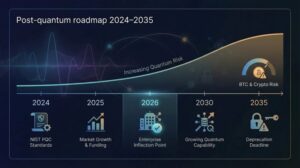
A post-quantum roadmap from NIST’s 2024 standards to the 2035 deprecation horizon highlights why 2026 is the enterprise inflection point.
Procurement shifted quickly. MarketsandMarkets values the post-quantum cryptography market at about US $0.42 billion in 2025 and US $2.84 billion by 2030, a forty-six percent compound annual growth rate. Venture funding mirrors the urgency: SandboxAQ raised more than US $300 million in December 2024 to expand migration tools.
By 2026 the standards will be a year old, formal guidance for retiring legacy algorithms will be public, and early enterprise pilots will have validated performance. Chief financial officers are likely to back full deployments instead of proofs-of-concept. Uncertainty about exactly when a cryptographically relevant quantum computer will exist does not mean you cannot size the risk. Public trackers such as Project 11’s Q-Day clock, Bitcoin Risq List, and research bulletins aggregate concrete advances in qubit hardware, error correction, and Shor’s algorithm and estimate that more than six million BTC, which is around 30 percent of the supply, already sits in addresses whose public keys are exposed to a future quantum attacker. That kind of measurement turns a vague someday threat into numbers that boards, regulators, and auditors can use when they decide how quickly migrations need to happen.
For CISOs the takeaway is straightforward: identify quantum-safe partners during 2025 so roll-outs can begin before 2026 budgets, and the top talent, are locked in elsewhere.
How we built the short list
- Evidence first. We collected data from Crunchbase, PitchBook, and the NIST post-quantum finalists list (October 2025) to spot vendors already in market or running regulated pilots.
- Tech reality check. A company needed a published patent, an open-source implementation, or a named contribution to the NIST competition to reach round two.
- Minimum traction. Each finalist also met at least one of these benchmarks:
- Ecosystem fit. The product must run one of the finalized NIST algorithms or integrate cleanly with standard TLS, IPsec, or PKI tools.
We excluded start-ups that only sell generic “quantum compute” services and incumbents still in beta. The outcome is a balanced mix of software, silicon, and hardware specialists you can buy today, each covering a different slice of the quantum-safe stack.
The four paths to quantum safety
Quantum risk shows up in multiple ways, so no single vendor covers every need. We group the seven companies into four practical lanes you can add to your security roadmap:

Four practical lanes—migration platforms, silicon IP, blockchain, and quantum hardware—structure a quantum-safe security roadmap.
- Enterprise migration platforms: discover weak cryptography and replace it with post-quantum algorithms on live networks.
- Crypto IP and silicon cores: build quantum-safe math directly into chips and secure elements.
- Blockchain security specialists: protect digital-asset keys and ledgers from future signature forgeries.
- Quantum communications and entropy hardware: deliver physics-grade randomness or photon-based keys for the most sensitive links.
Start with the lane that neutralizes your highest risk, then add others as budget and timelines allow.
Segment A – enterprise PQC migration platforms
SandboxAQ: automating cryptography upgrades
Alphabet spin-off SandboxAQ has raised about US $950 million since 2022, according to company filings. The AQtive Guard platform scans every TLS or IPsec session, inventories keys, and replaces weak ciphers with Kyber or Dilithium without downtime. On December 10, 2025, the U.S. Department of Defense signed a five-year production contract after a successful DISA pilot, as detailed in the contract announcement.

SandboxAQ’s AQtive Guard platform discovers non-human identity and cryptographic risks across enterprise networks.
QuSecure: post-quantum as a service
QuSecure’s cloud-delivered QuProtect installs inside existing networks and negotiates hybrid Kyber sessions end to end. The company protected a live U.S. Space Force satellite link in March 2023 and secured an additional US $28 million Series A extension led by Accenture Ventures in February 2025, according to the company’s press releases.
Post-Quantum: proven VPN and PKI replacements
London-based Post-Quantum has shipped quantum-safe VPN, chat, and PKI tools for more than ten years. A 2024 pilot with the U.K. National Cyber Security Centre and interoperability tests on Cisco hardware verify real-world compatibility, according to publicly available test reports.
Segment B – crypto IP and silicon building blocks
PQShield: hard-wiring post-quantum math into every chip
PQShield licenses lattice-based crypto cores that sign or decrypt with CRYSTALS-Dilithium or Kyber. Key points:
- Standards pedigree: company researchers co-authored Dilithium, one of NIST’s selected signature algorithms.
- Silicon traction: Arm integrated the core into its Corstone-310 reference design at Embedded World 2024, and NXP taped it into a secure-element pilot that began sampling in Q3 2025.
- Capital runway: PQShield raised US $27 million in Series A funding during January 2022, then secured another US $37 million in Series B funding during June 2024.
Companion software libraries mirror the hardware APIs, helping teams keep firmware and silicon in sync across servers, cards, and IoT devices.
Segment C – quantum-safe blockchain and web3
Project 11: preparing Bitcoin for quantum risk
Project 11 maintains a public “Q-Day Clock” that tracks research milestones and estimates when quantum computers could realistically shatter ECDSA signatures. Through its Project 11 Applied Quantum Computing initiative, the team ships an open-source SDK and Yellowpages registry that let exchanges bind lattice-based keys to existing Bitcoin addresses. The company also raised US $6 million in seed funding on June 19, 2025 to accelerate this work and expand its annual Quantum Wargames hackfest.
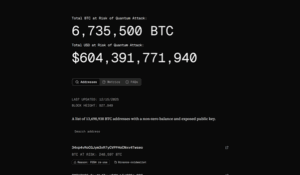
Project 11’s Q-Day Clock aggregates real quantum computing breakthroughs to estimate when attackers could realistically break today’s cryptography.
Current deliverables
- Yellowpages registry: lets exchanges bind a lattice-based key pair to an existing Bitcoin address and timestamp the proof off-chain for rapid recovery if ECDSA fails.
- Q-Day prize: offers one bitcoin to the first research group that breaks an ECC key with real quantum hardware, creating an open bug bounty.
- Quantum Wargames: an annual hackfest where defenders attack demo chains running hybrid Dilithium + ECDSA signatures; lessons feed directly into the SDK roadmap.
Custodians and Web3 developers can integrate the Project 11 SDK today, generate hybrid keys, and avoid a last-minute scramble if quantum attacks arrive sooner than expected.
Segment D – quantum communications hardware and key management
ID Quantique: physics-grade key delivery
ID Quantique’s Cerberis XG system sends single photons over fibre to generate symmetric keys that reveal any eavesdropper. Proof points:
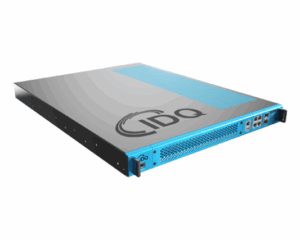
ID Quantique’s Cerberis XG QKD system delivers physics-grade key material over fiber for high-value backbone connections.
- Finance: Switzerland’s SIC inter-bank network secures the 70 km Geneva–Lausanne route with Cerberis.
- Mobile: more than one million Galaxy Quantum smartphones ship with the company’s 2.5 mm QRNG chip.
- Space: ESA’s EAGLE-1 mission carries an IDQ QRNG payload for satellite key distribution.
Pair these keys with NIST-approved algorithms to build a layered defence against nation-state threats.
QuintessenceLabs: quantum randomness plus enterprise KMS
Canberra-based QuintessenceLabs produces qStream, a quantum random number generator that delivers 1 Gbit/s of full-entropy bits and meets NIST 800-90B and FIPS 140-3. The same entropy feeds qCrypt, a KMIP-compliant key-management system already integrated with VMware vSphere 6.5. The hardware also supports Australia’s Defence Secure Network and a Telus 400 G trial. Total funding exceeds A$25 million from In-Q-Tel, Raytheon, and Telus Ventures. Replacing pseudo-random sources with qStream strengthens every downstream key before teams migrate to Kyber or Dilithium.
What Does Quantum-Safe Security Mean for Legal and Corporate Documentation?
Quantum-safe security isn’t just an IT concern — it directly affects how organizations document, store, and present sensitive evidence. As post-quantum encryption standards reshape how data is protected, legal teams, compliance officers, and enterprise security leaders face new requirements around tamper-proof documentation. Video evidence — including deposition recordings, corporate governance disclosures, and incident response briefings — must now be captured, stored, and transmitted using quantum-resistant methods to remain admissible, confidential, and audit-ready. Organizations migrating to NIST-approved algorithms should simultaneously audit how sensitive video records are produced and protected.
Quick-glance comparison
| Company | Core offering | Primary use case | 2025 proof point | Funding to date | Standards or government tie-in |
| SandboxAQ | Crypto discovery and automated swap platform | Enterprise-wide PQC migration | Five-year U.S. Department of Defense production contract, December 10, 2025 | USD 950 million raised since 2022 | NIST algorithms, DoD Impact Level 5 authorization |
| QuSecure | Cloud-delivered PQC orchestration | Rapid roll-out across mixed networks | Live U.S. Space Force satellite link, March 9, 2023 | USD 28 million Series A, closed February 12, 2025 | Accenture partnership, Department of Energy quantum network |
| Post-Quantum | PQ-ready VPN, chat, and PKI | Drop-in replacements for legacy tools | U.K. NCSC VPN pilot, 2024 field test | GBP 14 million plus EU grants | NATO testbed, Cisco interoperability |
| PQShield | Silicon IP and crypto libraries | Chipmakers, IoT, and payments | Arm and NXP demo cores, Embedded World 2024 | USD 27 million Series A | Co-author of NIST Dilithium |
| Project 11 | Quantum-safe blockchain SDKs | Exchanges, wallets, and Layer-1 chains | USD 6 million seed close, June 19, 2025 | USD 6 million | Funds lattice-cryptography research |
| ID Quantique | QKD, QRNG, and Layer-2 encryptors | High-value backbone links | Swiss SIC bank fibre (70 km) case study, 2023 | Majority stake held by SK Telecom | ITU QKD, ESA EAGLE-1 satellite |
| QuintessenceLabs | QRNG and key-lifecycle management | Enterprise crypto agility | VMware vSphere entropy plug-in, May 2024 | AUD 25 million in Series B and strategic rounds | In-Q-Tel, Raytheon, UK ANQ Pulse |
Use the table to match your highest-risk area with a vendor that has proven traction, then schedule a pilot before fiscal-year 2026 budgets close.
What’s still missing
Even the strongest vendors leave blind spots. Three stand out today:
- Revenue transparency. Few quantum-security start-ups publish annual recurring revenue. Until audited figures appear, rely on named customer references and third-party attestations such as SOC 2 or ISO 27001.
- Independent benchmarks. The current QKD distance record is 615 km over dark fiber (University of Science and Technology of China, June 2023), yet no commercial system has matched it. In live TLS tests Kyber swaps add less than 5 ms to the handshake on 10 GbE links (Cloudflare, 2022), but large-scale production data remain scarce. Request a controlled sandbox or proof-of-concept that measures latency, key rate, and failover on your own network.
- Cost clarity. Quotes often separate license, hardware, and professional-services fees. Ask for a five-year total-cost worksheet that covers refresh cycles, support tiers, and potential algorithm changes.
Capture these gaps in your migration plan now so budgets stay realistic and timelines hold up under board or regulator scrutiny.
The documentation gap in quantum migration planning
Most quantum migration roadmaps focus on encrypting data in transit — but they overlook a growing compliance blind spot: how sensitive organizational video records are created, transmitted, and stored. As quantum threats make legacy encryption brittle, any video asset that carries legal or financial weight needs the same scrutiny. Deposition services that record witness testimony for litigation are especially exposed — if the footage is transmitted or archived over vulnerable channels, its chain of custody and admissibility can be challenged. Similarly, engaging business videos used in investor communications, board presentations, or regulatory filings may carry material non-public information that demands quantum-safe handling end to end. Even event videography from corporate conferences or product launches — if it captures strategy, pricing, or personnel decisions — falls within the scope of data that CISOs are now expected to protect under the NIST post-quantum framework. Building video documentation protocols into your 2026 crypto inventory isn’t an edge case; it’s closing a gap that most migration checklists miss entirely.
Conclusion: 2026 outlook and your first moves
Quantum-safe security will become standard in 2026. Google Chrome already supports the hybrid X25519–Kyber768 key exchange for 19–26 percent of HTTPS traffic in stable channels, and AWS now offers post-quantum TLS on CloudFront, S3, and Load Balancers across every region. U.S. federal auditors plan to request post-quantum migration roadmaps in fiscal-year 2026 progress reports (OMB Memo M-23-02). Teams that pilot early avoid a scramble later.
A two-step sprint keeps you ahead:
- Complete a crypto inventory by Q1 2026.
-
- Run a discovery tool such as SandboxAQ, OpenSSL-scanner, or in-house scripts across every server, container, and device. Tag crown-jewel data with its required confidentiality lifetime; quantum-risk data often needs at least ten years of secrecy. You cannot patch what you cannot see.
- Pilot one quantum-safe link by Q2 2026.
- Pick a contained workflow—for example, a site-to-site VPN or a Git server. Turn on a hybrid Kyber handshake or, for nation-level data, install a short-haul QKD system. Measure handshake latency, certificate size, and recovery processes. Record results and budget impacts before rolling out at scale.
Reach these milestones and you will start 2027 with measurable progress, a vetted vendor list, and a board-approved migration budget rather than a compliance crisis.
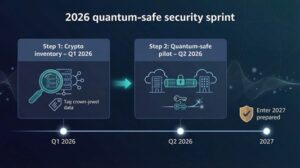
A focused two-step sprint—crypto inventory in Q1 2026 and a quantum-safe pilot in Q2—positions teams to enter 2027 prepared instead of scrambling.


