How to Evaluate Cybersecurity Vendors: The 2026 Strategic Checklist

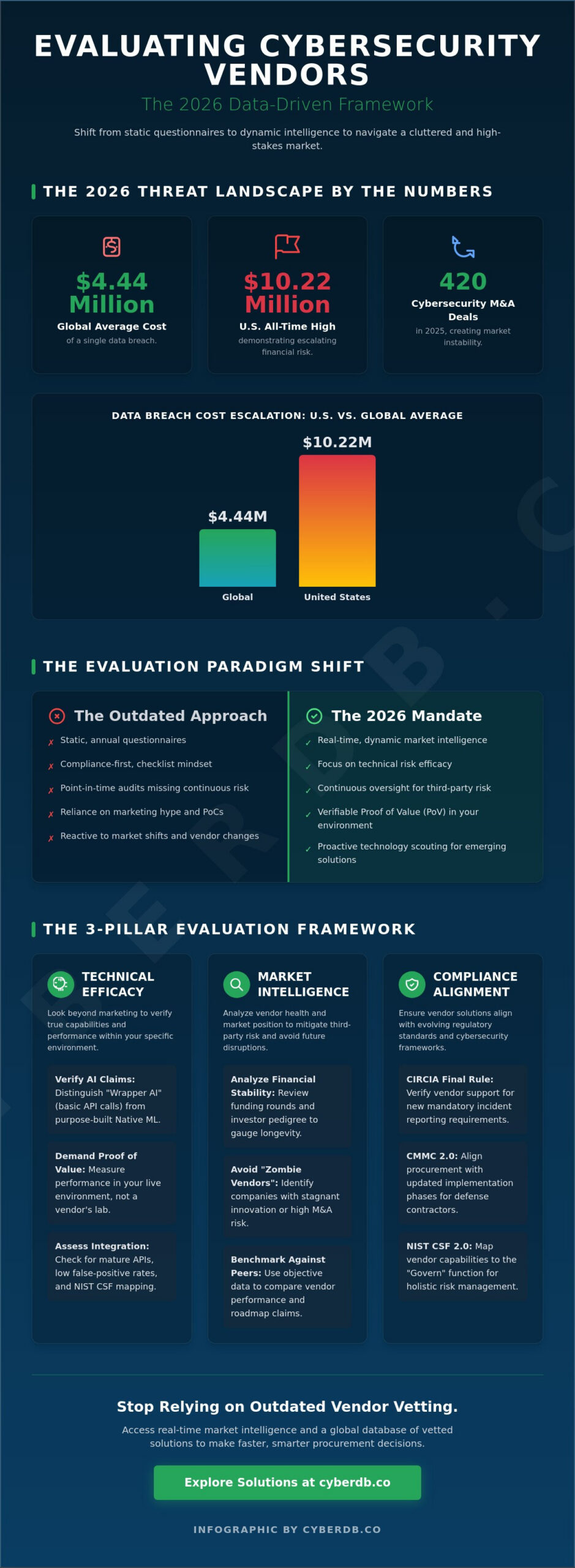
With the global average cost of a data breach reaching $4.44 million in 2026 and U.S. costs hitting an all-time high of $10.22 million, the stakes for your technology stack have never been higher. You’re likely exhausted by repetitive sales pitches and the 420 cybersecurity M&A deals recorded in 2025, which have left the Cyber Landscape cluttered with shifting product roadmaps and integration risks. Knowing how to evaluate cybersecurity vendors is no longer about checking boxes; it’s about verifying technical efficacy against a backdrop of mandatory CCPA cyber-risk audits and the CIRCIA final rule.
You recognize that marketing hype often obscures actual security performance, especially when every provider claims AI-native capabilities. This guide provides a meticulous, data-driven framework to help you strip away the noise, verify AI claims with objective intelligence, and ensure your providers align with the NIST CSF 2.0 “Govern” function. We’ll break down the 2026 strategic checklist, covering everything from CMMC 2.0 implementation requirements to assessing vendor financial stability using our Global Database.
Key Takeaways
- Learn how to evaluate cybersecurity vendors by shifting from static annual questionnaires to real-time market intelligence that reflects the 2026 threat environment.
- Identify the technical markers of native machine learning architecture to distinguish between genuine innovation and superficial “Wrapper AI” claims.
- Mitigate third-party risk by analyzing vendor funding rounds and investor pedigree to avoid “Zombie Vendors” and unexpected M&A disruptions.
- Align your procurement process with updated 2026 standards, including CIRCIA reporting requirements and CMMC 2.0 implementation phases.
- Utilize proactive technology scouting to discover emerging “white space” solutions before they reach mainstream market saturation.
The Shift in the 2026 Cybersecurity Vendor Landscape
The 2026 Cyber Landscape is undergoing a fundamental restructuring. While global cybersecurity spending is projected to exceed $520 billion this year, the market remains split between massive integrated platforms and highly specialized AI-native startups. Traditional annual questionnaires haven’t kept pace with this velocity. Procurement cycles that used to take six months are now compressed by the urgent need to defend against automated, AI-driven threats. Decision-makers must shift their focus from a compliance-first mindset to one centered on risk efficacy. This transition ensures that tools actually stop modern attacks rather than just satisfying a legacy auditor’s checklist. Understanding how to evaluate cybersecurity vendors requires a move away from static documentation toward dynamic market intelligence.
The Failure of Static Vendor Vetting
Static, point-in-time audits are increasingly ineffective for securing SaaS-heavy environments. Vulnerabilities in cloud-based security tools can emerge days after a questionnaire is signed, leaving organizations exposed to supply chain attacks. Relying solely on a Common Criteria certification provides a solid baseline for product security, but it doesn’t account for the operational risks of continuous delivery models. The 420 cybersecurity M&A deals recorded in 2025 demonstrate how quickly a vendor’s roadmap can shift, potentially introducing new security gaps. Modern regulatory requirements, like the CIRCIA final rule effective May 2026, demand a more dynamic approach to oversight. You can’t manage third-party risk if your assessment data is six months old.
The CISO’s New Evaluation Mandate
CISOs now face the challenge of balancing technical debt with the adoption of cutting-edge protection. Effectively learning how to evaluate cybersecurity vendors in this environment involves integrating real-time market intelligence into the initial discovery phase. This proactive stance helps identify “Zombie Vendors” or companies likely to be absorbed in the next wave of consolidation, such as the major acquisitions seen by Google and Palo Alto Networks in late 2025. For a deeper dive into these strategic shifts, consult The CISO’s Guide to the Cybersecurity Vendor Landscape in 2026. By prioritizing technology scouting, security leaders can align their toolsets with business goals while reducing the friction of vendor lock-in and ensuring long-term stability.
Technical Efficacy: Verifying AI and Product Claims
Technical efficacy in 2026 hinges on the ability to look past marketing terminology. Many providers claim advanced artificial intelligence capabilities, but the architecture behind these claims determines actual defensive power. When determining how to evaluate cybersecurity vendors, you must move beyond the standard Proof of Concept (PoC) toward a Proof of Value (PoV). A PoV measures how a tool performs within your specific production environment rather than relying on sanitized vendor data. This shift is essential for verifying algorithmic transparency and ensuring that automated responses align with your internal risk thresholds.
Auditing AI-Powered Security Claims
The distinction between “Wrapper AI” and native machine learning architecture is critical for long-term security. Wrapper solutions often rely on basic API calls to external large language models, which can introduce latency and data privacy risks. Native models are purpose-built for threat detection and trained on specialized security datasets. You should ask vendors about their training data sources and how they mitigate model bias. Verifying real-time detection rates against your own traffic is more reliable than viewing historical lab results. To compare these technical specifications across the market, you can leverage the AI Categories and Vendors Database to benchmark performance claims against industry peers.
Performance and Integration Testing
Integration maturity determines whether a new tool becomes an asset or a burden. High “False Positive” rates can overwhelm a SOC team already struggling with the global workforce gap of 4.8 million unfilled cybersecurity positions. Testing should involve assessing API maturity and how well the solution maps to the NIST Cybersecurity Framework. Data residency remains a primary concern. Ensure the vendor provides granular controls over where AI training data is stored and processed. Evaluating these factors helps prevent technical debt and ensures the tool addresses emerging 2026 threat vectors like adversarial AI. For organizations needing deeper technical insights, utilizing a comprehensive AI vendors database can streamline the vetting process during the initial research phase.
Market Intelligence: Assessing Vendor Stability and M&A Risk
Market intelligence is the most overlooked component of vendor vetting. In 2025, the industry saw over 420 M&A deals with a total disclosed value exceeding $84 billion. This level of consolidation means the tool you purchase today might be owned by a competitor tomorrow. Understanding how to evaluate cybersecurity vendors requires a deep dive into their financial stability and investor pedigree to predict these shifts. Relying on community sentiment or reputation isn’t enough; you need hard data on funding velocity and ownership structures to avoid the risk of “Zombie Vendors,” companies that have ceased innovating but continue to collect maintenance fees.
Analyzing the Vendor’s Corporate Health
A vendor’s corporate health directly impacts the longevity of your security posture. High marketing expenditure paired with low R&D spend often signals a company preparing for an exit rather than one committed to long-term product efficacy. You should utilize the Cyber Security Companies Database to cross-reference a provider’s market standing against their competitors. This objective data helps you verify if a vendor has the capital to sustain its roadmap through 2026 and beyond. Integrating these insights into your NIST cybersecurity supply chain framework ensures that you aren’t just assessing software, but the stability of the organization delivering it.
The Startup vs. Legacy Vendor Trade-off
Choosing between an agile startup and a legacy incumbent involves a calculated trade-off between innovation speed and operational stability. Startups often provide the specialized capabilities needed to combat 2026’s AI-driven threats, but they may lack the support infrastructure for multinational deployments. Conversely, incumbents offer stability but might suffer from feature bloat or slow integration of new technologies. Using Cybersecurity Market Intelligence allows procurement teams to identify “white space” solutions that offer startup-level innovation with a clear path to market maturity. This strategic scouting reduces the risk of vendor lock-in with unstable providers while ensuring your security stack remains capable of meeting business goals. Accurate intelligence also provides the leverage needed to negotiate contract terms that protect your data in the event of an acquisition.
The Operational and Compliance Checklist
Compliance in 2026 is no longer a static achievement. The Cybersecurity and Infrastructure Security Agency (CISA) released the final rule for the Cyber Incident Reporting for Critical Infrastructure Act (CIRCIA) in May 2026, requiring covered entities to report significant incidents within 72 hours and ransomware payments within 24 hours. This mandate forces a shift in how to evaluate cybersecurity vendors, as your providers must now possess the internal telemetry and reporting maturity to support these rapid timelines. Relying on legacy SOC-2 Type II reports is insufficient when facing the Phase 1 requirements of CMMC 2.0, which runs through November 9, 2026, or the updated GSA IT security guidance effective as of February 2026.
Modern security agreements must move beyond boilerplate language to include legal “must-haves” that protect your organization from third-party volatility. Ensure all contracts include “right to audit” clauses and clear data residency stipulations that align with regional laws like GDPR and the evolving state-level privacy landscape. You should also establish a weighted scoring matrix to maintain objectivity throughout the procurement process. This matrix should prioritize technical efficacy and regulatory alignment over initial cost, allowing you to quantify how to evaluate cybersecurity vendors based on your specific business goals. Telemetry must be verifiable. Audit clauses are mandatory. Without these protections, you risk inheriting the vendor’s technical debt and compliance gaps.
Regulatory and Security Documentation
Beyond basic certifications, operational due diligence requires a deep dive into a vendor’s internal security program. The NIST Cybersecurity Framework (CSF) 2.0, released in February 2024, introduced the “Govern” function to emphasize this type of oversight. You should verify zero-trust architecture claims through rigorous reviews rather than accepting marketing collateral. This is critical given the 2026 CCPA requirements for mandatory cyber-risk audits. If a vendor can’t demonstrate how they secure their own pipeline, they represent a weak link.
Service Level Agreements (SLAs) and Support
SLAs must reflect the urgency of the 2026 threat landscape. Acceptable Mean Time to Repair (MTTR) for critical vulnerabilities should be clearly defined. The UK’s “Denzell” update to Cyber Essentials enforces stricter patching controls as of April 27, 2026. When conducting reference calls, ask about the vendor’s transparency during past breaches. Evaluate documentation quality, as the global shortage of 4.8 million cybersecurity professionals means your team needs intuitive tools. For a comprehensive view of providers categorized by these specific capabilities, you can explore the Cyber Security Categories Database to refine your shortlist.
Strategic Scouting: Proactive Vendor Discovery
The final phase of a 2026 security strategy involves moving from reactive selection to proactive discovery. While many organizations wait for vendors to approach them, elite security teams utilize Cybersecurity Technology Scouting to find solutions that address specific gaps before those gaps become liabilities. This proactive approach is the first step in mastering how to evaluate cybersecurity vendors because it defines technical requirements based on actual threat data rather than marketing trends. By the time a solution hits the mainstream, it often carries a premium price and a legacy architecture that may not suit your specific environment.
Identifying “white space” solutions requires a shift in perspective. These are niche technologies that solve emerging problems, such as adversarial AI defense or machine identity management, which the larger platform providers haven’t yet integrated. Understanding Why a Cybersecurity Vendor Database is a Strategic Asset becomes clear during this phase. Access to a global repository of providers allows you to filter by R&D stage, funding history, and geographical residency. This granularity is essential for complying with the CIRCIA final rule or CMMC 2.0 implementation phases, where knowing the origin and stability of your software is a legal necessity.
Finding Emerging Tech Partners
Proactive discovery involves mapping niche startups that are still in the R&D stage. Using specialized databases to filter by category and tech stack ensures you’re looking at the most relevant candidates. Strategic channel partners also play a role in this ecosystem, helping bridge the gap between innovation and enterprise-grade support. Organizations often leverage Business Development Services to identify these partners and facilitate early-stage technical vetting. This method prevents the vendor fatigue often cited by CISOs who are bombarded by repetitive sales pitches for generic tools.
Building a Future-Proof Security Ecosystem
A successful evaluation process ends with a strategic partnership, not just a signed contract. You must ensure interoperability between new vendors and your existing infrastructure to prevent the SOC from becoming a collection of siloed tools. Planning for the sunset phase of the relationship is equally important. As the 420 M&A deals in 2025 proved, vendor stability can change overnight. Setting up a continuous evaluation cycle ensures that you’re always aware of better alternatives in the Cyber Landscape. This ongoing vigilance is how to evaluate cybersecurity vendors effectively over the long term, preventing technical stagnation and maintaining alignment with your business goals.
Securing Your Infrastructure Through Strategic Intelligence
The 2026 Cyber Landscape demands a departure from legacy procurement methods. Successfully learning how to evaluate cybersecurity vendors requires a synthesis of technical verification, market intelligence, and regulatory alignment. You’ve seen how the 420 M&A deals in 2025 and the CIRCIA final rule of May 2026 have shifted the baseline for acceptable third-party risk. By prioritizing algorithmic transparency and corporate stability, you ensure your security stack isn’t just compliant but resilient against automated threats.
Data is your most effective tool for navigating this complexity. Instead of relying on vendor self-assessments, leverage objective market intelligence to verify roadmap viability and investor backing. Our Global Database provides comprehensive data on over 5,000 cybersecurity and AI vendors, offering real-time updates on market trends, M&A activity, and funding rounds. This intelligence is why top CISOs and VCs trust us for deep-dive technology scouting. Access the Global CyberDB Vendor Database to streamline your evaluation process today. You now have the framework to build a future-proof ecosystem that protects both your data and your business goals.
Frequently Asked Questions
What are the most important criteria when evaluating a cybersecurity vendor?
Technical efficacy, interoperability, and operational support are the primary criteria. You must ensure the tool integrates with your existing security stack without increasing the false positive burden on your SOC team. Prioritize vendors that offer transparent documentation regarding their detection logic and data handling practices to ensure alignment with your internal risk thresholds.
How do I verify if a vendor’s AI claims are actually effective?
Auditing algorithmic transparency and requesting model lineage documentation is the best way to verify AI effectiveness. You should distinguish between native machine learning architectures and “Wrapper AI” that simply calls external APIs. Effective AI must demonstrate real-time detection capabilities against your specific network traffic during a Proof of Value rather than relying on sanitized lab data.
Why should I check a vendor’s investment and M&A history?
Investment history reveals a vendor’s financial runway and the likelihood of a disruptive acquisition. A provider with backing from top-tier venture capital firms often has more resources for R&D than those relying on debt. Checking M&A history helps you predict if your data might be transferred to a larger entity, which occurred in over 420 deals during 2025.
Is a SOC-2 report enough to validate a vendor’s security in 2026?
SOC-2 reports are insufficient because they represent a point-in-time audit rather than a continuous security posture. In 2026, you need to validate a vendor’s alignment with the NIST CSF 2.0 “Govern” function and their ability to meet the 72-hour reporting mandate of the CIRCIA final rule. Documentation should prove ongoing vulnerability management and secure software development lifecycles.
How can I speed up the cybersecurity vendor evaluation process?
Utilizing a centralized database of over 5,000 providers is the most efficient way to learn how to evaluate cybersecurity vendors quickly. This approach replaces manual research with structured market intelligence, allowing you to filter by technology category, region, and funding status. Technology scouting services can further compress the discovery phase by providing a pre-vetted shortlist of candidates tailored to your needs.
What is the difference between a product trial and a Proof of Value (PoV)?
A product trial focuses on exploring features and the user interface, while a Proof of Value (PoV) measures specific security outcomes in a production environment. The PoV is designed to quantify risk reduction and calculate potential return on investment. It requires clear success metrics, such as a 30% reduction in incident response time or a specific detection rate for zero-day threats.
How do I assess the risk of a cybersecurity startup going out of business?
Assessing a startup’s risk involves analyzing their cash runway and the pedigree of their lead investors. In the 2026 Cyber Landscape, startups with less than 18 months of runway are considered high-risk for “Zombie Vendor” status. You should request a roadmap that includes contingency plans for service continuity in the event of a merger or liquidation to avoid vendor lock-in with an unstable provider.
What specific clauses should be in a 2026 cybersecurity vendor contract?
2026 contracts must include “right to audit” clauses, data residency requirements, and clear sunsetting provisions. These legal protections ensure you can verify security claims and move your data if the partnership ends. Agreements should also specify Mean Time to Repair (MTTR) for critical bugs to ensure the vendor supports your compliance with updated patching standards like the UK’s “Denzell” update.
Tags: CIRCIA, CMMC 2.0, Cybersecurity, IT Procurement, NIST CSF 2.0, Third-Party Risk, Vendor Assessment, Vendor Management


