Data Destruction Methods and Best Practices for Compliance
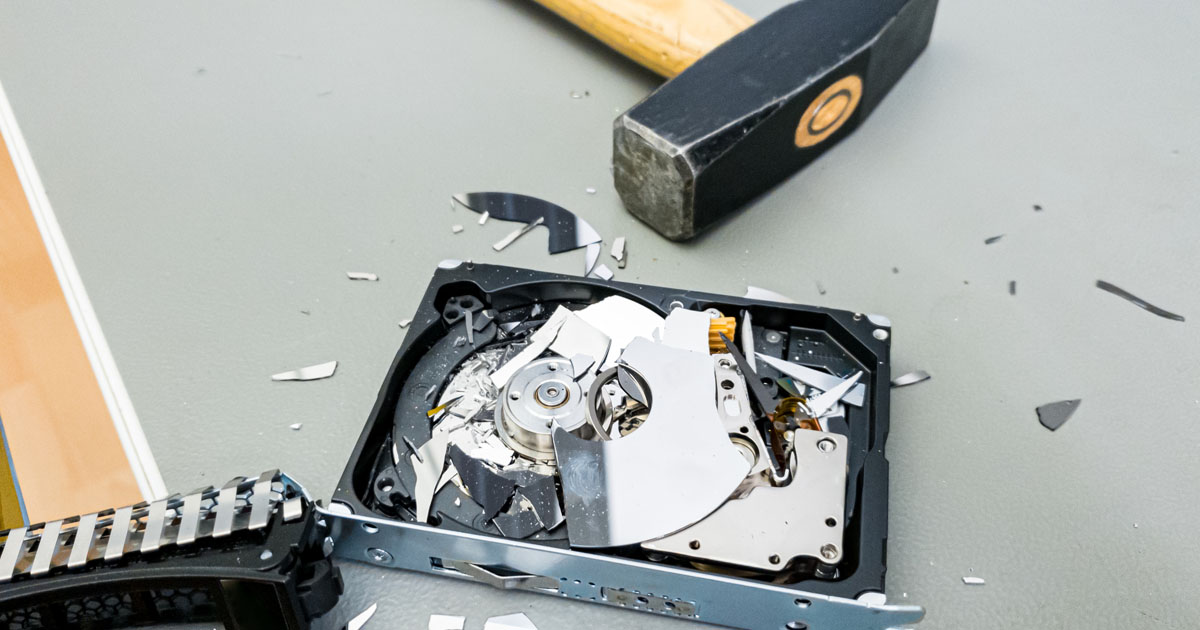
Safeguarding data is non-negotiable for businesses today, no matter which industry they belong to. Whether it’s personal customer information, employee records, or company IP, organizations must ensure that data doesn’t fall into the wrong hands. Secure data destruction becomes crucial here by ensuring that data is permanently removed and cannot be recovered or misused.
Organizations follow two approaches to achieve data destruction compliance. The first approach is physical destruction, in which data-bearing devices are physically destroyed by using methods like shredding and pulverization to physically break the device apart, or degaussing, which erases data by demagnetizing the storage medium without causing visible physical damage. The logical destruction methods like overwriting, Secure Erase, Block Erase, and Cryptographic Erase permanently remove data by using logical data destruction techniques without damaging the storage media.
Both of these approaches have their merits, but businesses must first understand their unique data security, environmental, and social obligations before deciding the right approach for data destruction.
Physical Destruction
Physical destruction refers to all the data destruction methods that aim to obliterate storage media by using mechanical or magnetic means. The purpose of these methods is to ensure that the data on the identified media device becomes irrecoverable.
Some of the key physical destruction techniques are:
Shredding
In this method, industrial machines (that have blades or hammers) are used to tear storage devices (like hard drives, CDs, and tapes) into small fragments. Such fragments are as small as 2mm.
Shredding can significantly reduce the risk of data recovery, but in high-density storage drives, enough data can exist in small fragments to make data recovery viable. Because of this, newer media sanitization standards like IEEE 2883-2022 do not recommend shredding.
Pulverization
In this technique, high-force grinders or mills are used to crush devices into dust or tiny particles in a way that meets NSA/CSS standards for classified data. This is the most thorough physical destruction method and leaves no recoverable remnants.
Degaussing
While degaussing may not seem like a physical destruction method as the storage media remain physically intact, it destroys their data storage capability, making them useless. In this technique, a strong electromagnetic pulse of 5,000 to 20,000 Oersteds (Oe) is used to disrupt magnetic fields on a hard drive or magnetic tape. This pulse scrambles the magnetic domains that store data, making the data unreadable and rendering the device unusable.
Technically it is possible to make a degaussed device reusable, but the effort and cost for the same are not viable.
Physical destruction methods are ideal when the devices are damaged, inaccessible, have multiple bad sectors, or contain highly confidential data. However, physical destruction methods are ideally used as a last resort. That’s because of their environmental drawbacks, as they produce a lot of e-waste.
Logical Destruction
Logical destruction focuses on erasing data electronically. So, the methods included in logical data destruction allow for the reuse of the storage device.
Key logical data destruction methods are:
Overwriting
In this process, existing data is replaced with new, random data. This makes the original data unrecoverable. Overwriting can be performed multiple times to enhance the effectiveness of the data destruction. However, with the advancement of overwriting algorithms, a single overwrite pass can suffice, for example, the NIST Clear method for ATA Hard Disk Drives.
Secure Erase
In this technique, devices use internal firmware commands to overwrite data beyond recovery. For example, the ATA secure erase (relevant for HDDs & SATA SSDs) overwrites all Logical Block Addresses (LBAs). It has two modes:
- Normal Erase: Overwrites user-addressable sectors with zeros or ones.
- Enhanced Erase: Erases all sectors, including reallocated and hidden areas.
Block Erase
In this method, large blocks of data are erased simultaneously to ensure that all the data within the block is securely deleted. It is used in SSDs and flash memory devices. In SSDs, due to wear-leveling mechanisms, standard overwriting is not reliable. Instead, Block Erase Commands (ATA/NVMe Secure Erase) reset all data blocks to a factory state, ensuring complete erasure.
Cryptographic Erase
In this technique, data is encrypted, and the encryption keys are securely deleted. Without the keys, the encrypted data becomes unreadable. This effectively makes the original information irrecoverable.
Also read: Data Destruction Methods and Techniques
Best Practices for Data Destruction
Any organization that handles personal, financial, or proprietary data has to implement best practices to manage their data securely and to avoid penalties.
There are four major pillars of an effective data destruction strategy:
Create a formal and documented Data Destruction Policy that outlines specific steps, methods, and schedules for securely destroying data tailored to the organization’s needs. Key Components of a Data Destruction Policy include the following components:
- Scope & Objective of the Policy
- Data Classification according to sensitivity
- Data Destruction Method to be used
- Roles & Responsibilities of data destruction technician and validator
- Chain of Custody procedures and documentation to be maintained
- Audit & Policy Review Procedures
- Incident Response & Policy Enforcement protocols
- Corrective Action Plans
Follow Media Sanitization Guidelines from NIST SP 800-88, IEEE 2883-2022, and DoD 5220.22-M are media sanitization standards that specify how data should be securely erased or destroyed. On the other hand, ISO 27001 is an information security certification that integrates data destruction into a broader security management system.
Below is an overview of key media sanitization standards and certifications:
- NIST SP 800-88 (Media Sanitization Standard): Defines three methods of sanitization:
- Clear: Logical erasure methods such as overwriting
- Purge: Methods like overwrite, cryptographic erasure or degaussing
- Destroy: Physical destruction of devices using a shredder or incinerator.
- IEEE 2883-2022 (Standard for Sanitizing Storage): A more contemporary standard compared to NIST SP 800-88, which was published in 2022. It defines three levels of sanitization:
- Clear: Techniques like overwriting or block erasing to prevent simple data recovery
- Purge: Combines logical and physical techniques, such as sanitize overwrite, cryptographic erasure, block erase, or degaussing
- Destruct: Physical destruction by incineration or disintegration; shredding is not recommended for SSDs due to risks of data remnants in chips
- DoD 5220.22-M (Sanitization Standard – Deprecated): A historically recommended three-pass overwrite method (writing 1s, 0s, and random data) to sanitize magnetic storage. No longer a best practice but is still referenced in some policies.
Meticulous Record-keeping and documentation must be maintained for the data destruction process. It is crucial for compliance with data protection and privacy laws and voluntary certifications. See sample Certificate of Destruction.
Essential Components of Data Destruction Records:
- Date & Time of data destruction
- The data destruction method used
- Hardware Details like model name, serial number, size, type, number of sectors, manufacturer, etc.
- Name, organization, and signature of the technician performing the destruction and the person validating the process.
- Success or failure of data destruction
Maintaining data confidentiality and data destruction is a shared responsibility for IT teams, IT Asset Managers, and CISOs. So, regular audits are essential to verify that data destruction policies are followed.
IT personnel responsible for data security should receive specialized training on:
- The latest data destruction tools and techniques
- Proper record-keeping practice
- Industry regulations such as GDPR, HIPAA, and ISO 27001.
While IT teams handle the technical aspects of data destruction, general employees must also be educated on:
- The importance of data security
- The consequences of data breaches
- Their role in maintaining confidentiality
Also read: 10 Crucial Data Erasure Best Practices Every Business Must Implement
Conclusion
Data destruction is a crucial part of the media sanitization process for organizations. A robust data destruction strategy is vital not only for legal and regulatory compliance but also to prevent the risks of reputational damage. For data destruction compliance organizations need a well-rounded strategy. Such a strategy should help relevant individuals take the right decisions on data destruction methods.


