Cybersecurity M&A Trends in 2026: The Era of Platformization and AI-Native Integration

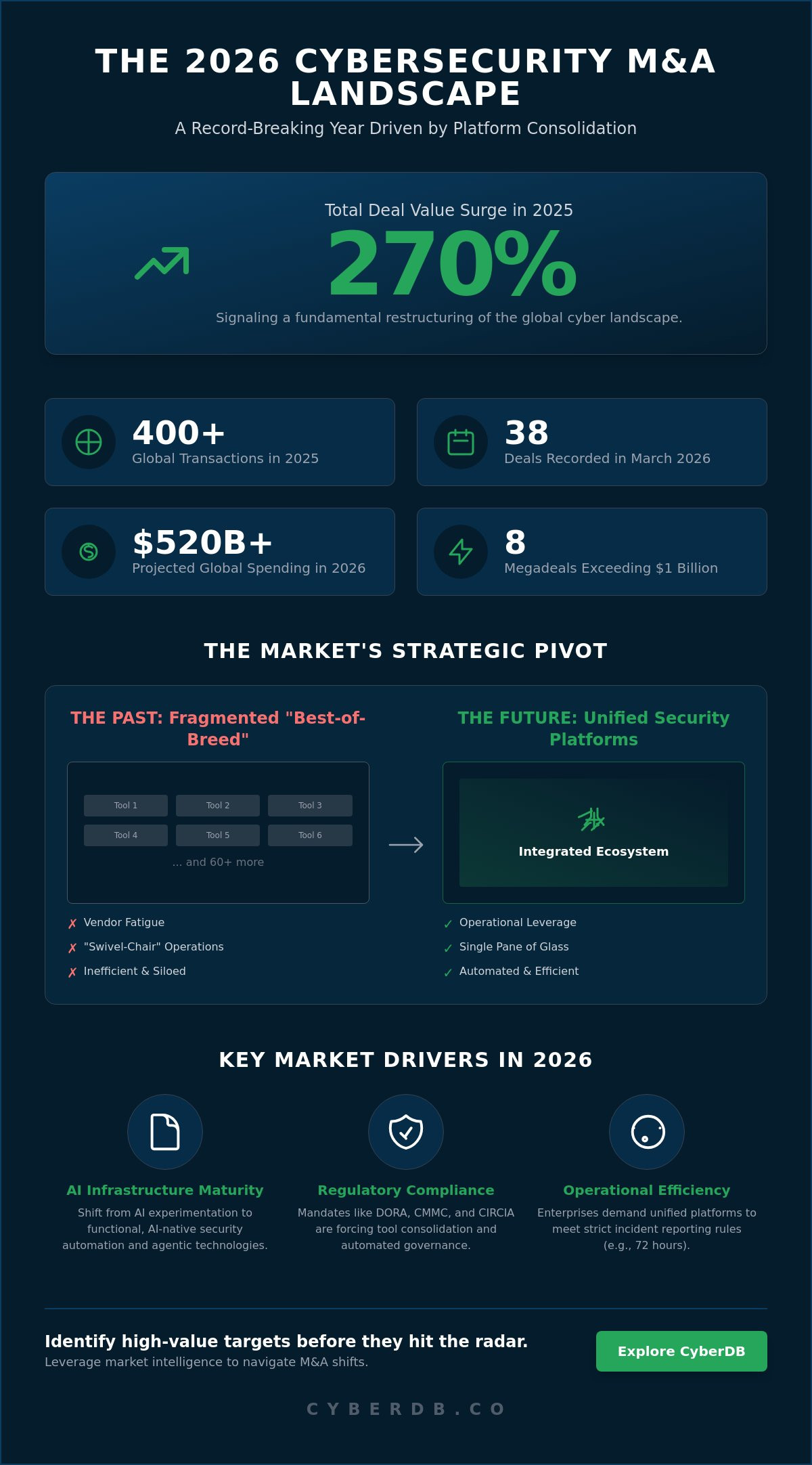
The 270% surge in total deal value during 2025 signaled a fundamental restructuring of the global Cyber Landscape. With 38 deals announced in March 2026 alone, the momentum behind cybersecurity m&a trends isn’t just about volume; it’s a strategic pivot toward exposure management and AI-native integration. Most CISOs feel the weight of vendor fatigue, managing dozens of niche tools that often fail to communicate. You’ve likely experienced the frustration of “orphaned” products following an acquisition or the struggle to track which AI-security startups provide long-term value.
This analysis examines the transition from fragmented point solutions to unified security platforms, a shift driven by eight megadeals exceeding $1 billion in the past year. We’ll explore how global spending, projected to exceed $520 billion in 2026, is gravitating toward vendors that prioritize operational leverage over manual labor. By leveraging insights from our Global Database, you’ll identify stable technology partners and understand the valuation drivers for AI-security startups. We’ll also detail how new regulations like DORA and the CMMC Final Rule are forcing acquisitions that prioritize compliance and automated governance.
Key Takeaways
- Analyze the current cybersecurity m&a trends where record-breaking deal volume is driven by a fundamental shift from niche tools to unified security platforms.
- Understand why “best-of-breed” solutions are being absorbed into integrated platforms to reduce vendor fatigue and streamline security operations across the enterprise.
- Distinguish between AI-enabled wrappers and AI-native startups to identify which agentic technologies are commanding the highest acquisition premiums in the current market.
- Learn to spot investment “white space” in the 2026 Cyber Landscape by utilizing proactive technology scouting to find high-value targets before they hit the general radar.
The 2026 Cybersecurity M&A Landscape: A Record-Breaking Year
The 2026 Cyber Landscape has reached an unprecedented inflection point. Total deal value in 2025 surged by nearly 270% compared to the previous year, while the number of global transactions exceeded 400. This momentum continued into the first quarter of 2026, with 38 deals recorded in March alone. These cybersecurity m&a trends represent a departure from the fragmented best-of-breed era toward a consolidated ecosystem where platform depth defines market dominance. Large technology and security companies are driving this through acquisitions to offer comprehensive solutions that eliminate the inefficiencies of managing disparate niche tools.
Strategic corporate “platform-filling” has largely replaced the private equity “buy-and-build” model that dominated the early 2020s. We’re seeing non-traditional buyers, such as ServiceNow and Veeam, aggressively enter the pure-play security market to integrate protection directly into operational workflows. This evolution is mirrored in the history of cybersecurity consolidation, which illustrates how established entities continuously absorb specialized tools to maintain market relevance. Consolidation is the new mandate. Today, these acquisitions focus on creating a seamless fabric between IT operations and threat defense, moving away from isolated security silos.
Key Market Drivers in 2026
Valuations stabilized in early 2026 following a necessary correction period throughout 2024 and 2025. This stability allows for more predictable cyber investment strategies as global spending on security products is predicted to exceed $520 billion annually. Several factors contribute to this renewed activity:
- AI Infrastructure Maturity: The transition from Generative AI experimentation to functional, AI-native security infrastructure.
- Regulatory Compliance: Mandates like the EU’s Digital Operational Resilience Act (DORA) and U.S. CIRCIA rules forcing tool consolidation.
- Operational Efficiency: Enterprises prioritizing “single-pane-of-glass” solutions to meet strict 72-hour incident reporting requirements.
The Surge of $1 Billion-Plus Transactions
The market witnessed eight megadeals exceeding $1 billion in 2025, a trend that accelerated into Q1 2026. Major vendors like Palo Alto Networks are no longer just buying for market share; they’re acquiring specific capabilities in exposure management and data observability. Private equity firms, including Francisco Partners, remain active in mid-market consolidation, but the focus has shifted toward companies that demonstrate operational leverage. Buyers are rewarding startups that reduce dependency on manual labor and automate critical security processes, reflecting a broader market move toward efficiency and platformization.
The Rise of the Cybersecurity Platform: Why Best-of-Breed is Fading
The shift toward platformization is a direct response to the operational friction caused by the average enterprise managing over 60 disparate security tools. CISOs are actively consolidating their stacks to reduce the “swivel-chair” effect, where analysts must jump between consoles to investigate a single incident. This demand is reshaping cybersecurity m&a trends, as legacy giants and hyperscalers acquire specialized startups to fill critical gaps in their unified offerings. According to the Cybersecurity Market Size 2026 analysis, the drive for architectural cohesion is a primary catalyst for the current growth in deal activity.
Cloud-Native Application Protection Platforms (CNAPP) have emerged as the most contested territory in the 2026 M&A market. By merging posture management, workload protection, and entitlement management, CNAPP provides the comprehensive visibility that fragmented best-of-breed tools lack. Similarly, Extended Detection and Response (XDR) is no longer viewed as a standalone category. It has been absorbed into broader Security Operations (SecOps) suites that leverage AI-native automation to correlate telemetry across the entire infrastructure. The goal is to provide a single source of truth for the entire attack surface.
From Niche Tools to Unified Ecosystems
Standalone vendors in categories like Endpoint Detection and Response (EDR) or Web Application Firewalls (WAF) are increasingly vulnerable to acquisition. These technologies now serve as essential telemetry sources for larger platforms rather than independent silos. Exposure Management has become the strategic glue for these integrations, allowing vendors to provide a continuous view of the attack surface. To understand how these transitions affect the market, organizations can consult the CyberDB Categories to map where specific vendors sit within the evolving ecosystem.
The Impact on CISOs and Vendor Selection
For decision-makers, the risk of “feature atrophy” is a significant concern during an acquisition. When a nimble startup is integrated into a larger corporate structure, innovation often slows, and the product may be relegated to a maintenance-only status. Utilizing a Cybersecurity Vendor Database allows teams to monitor post-acquisition stability and track whether the technology roadmap remains aligned with their needs. Effective evaluation requires a rigorous cybersecurity due diligence framework to determine if a newly acquired tool will genuinely enhance a platform or simply add technical debt. If you are evaluating a potential partner, our team can provide a detailed product strategy assessment to ensure long-term alignment with your security architecture.
AI-Native Acquisitions: Moving Beyond Generative Hype
The 2026 Cyber Landscape has moved past the era of “AI-wrappers,” which are products that simply add a chat interface to legacy tools. In the current cycle of cybersecurity m&a trends, the highest premiums are reserved for AI-native companies where machine learning is the foundational architecture. These acquisitions are driven by the need to secure the rapid enterprise deployment of Large Language Models (LLMs) and the resulting demand for AI Governance and AI Security (AISec) tools. For a technical deep dive into these shifts, consult the Definitive Guide to AI in Cybersecurity.
Acquirers are prioritizing operational leverage. They want technologies that reduce the human-to-incident ratio. This is particularly evident in the 38 cybersecurity-related m&a deals announced in March 2026. Buyers are no longer satisfied with “AI-enabled” marketing; they require proof of autonomous decision-making capabilities that can withstand the rigors of the NIST Cybersecurity Framework (CSF) 2.0 governance standards.
The Hunt for Agentic Security
Autonomous security agents represent the most significant M&A target in 2026. Unlike traditional automation that follows static playbooks, these agentic systems can reason, adapt, and execute multi-step incident response tasks without human intervention. In the Application Security (AppSec) sector, agentic tools are already replacing manual vulnerability triaging. Strategic buyers are actively utilizing AI Vendor Databases to identify these startups before they reach Series B funding. This proactive scouting is essential because the window for acquisition is shrinking as hyperscalers compete for the same talent pools.
Vetting AI Claims During Due Diligence
Due diligence in 2026 requires a rigorous filter to bypass “AI-washing.” Corporate development teams now prioritize three specific metrics:
- Data Moat Quality: Does the vendor possess unique, high-fidelity datasets that competitors can’t easily replicate?
- Integration Latency: How quickly can the AI-native engine ingest and process telemetry from a standard XDR suite?
- Model Proprietary-ness: Is the technology built on a generic API or a fine-tuned, purpose-built architecture?
AI-native security is a system where machine learning is the primary control plane, not an add-on. Without this core integration, a target’s valuation often drops by 30% during final audit phases. We’ve seen this play out in the recent megadeals where platform alignment was the deciding factor in the final purchase price.
Strategic Implications for VCs and Corporate Development
The record-breaking deal volume of 2025 shifted the focus of venture capital and corporate development teams toward identifying “white space” in the 2026 Cyber Landscape. While platformization consolidates existing categories, significant gaps remain in areas like automated compliance for the CMMC Final Rule and the EU’s DORA regulations. These cybersecurity m&a trends indicate that strategic buyers now prioritize targets that solve specific regulatory friction points or architectural bottlenecks. To stay ahead of these shifts, firms are increasingly relying on Technology Scouting to find high-potential startups before they attract broad market attention.
Exit strategies for startups in 2026 have diverged from the traditional IPO path. Acquisition remains the primary liquidity event as hyperscalers and security giants look to round out their platforms. For corporate development teams, the challenge lies in distinguishing between companies with genuine operational leverage and those relying on temporary market hype. Strategic buyers are rewarding companies that reduce dependency on manual labor, especially as global spending on cybersecurity products is predicted to exceed $520 billion annually. Request a custom technology scouting report to identify undervalued targets in the 2026 market.
Mapping the R&D Landscape
Venture capital is shifting toward stealth-mode startups that address foundational infrastructure risks. Quantum-Resistant Cryptography has become a major focus area as enterprises look toward the 2030 migration deadlines. Utilizing Cyber Investment Research is essential for identifying these emerging segments before they reach the mainstream. Real-time monitoring of M&A activity allows investors to pivot their strategies when a specific category, such as identity security, becomes overcrowded or fully consolidated by dominant platform players.
The Israeli Cyber Ecosystem as an M&A Engine
The Israeli ecosystem continues to serve as the primary R&D lab for US-based security giants. We’re seeing a consistent trend of “acqui-hiring” where firms are bought primarily for their specialized talent in threat intelligence and offensive security. This is particularly relevant as organizations struggle to meet the 72-hour incident reporting requirements of CIRCIA. Monitoring the Israeli Cyber Landscape provides the early-stage signals needed to spot these innovators. These startups often provide the “missing piece” for platforms looking to automate complex incident response workflows and satisfy rigorous new due diligence standards.
Leveraging Market Intelligence to Navigate M&A Shifts
Static reports are insufficient for capturing the velocity of the 2026 Cyber Landscape. Relying on annual or even quarterly snapshots leads to “investment blindness,” where corporate development teams overpay for legacy technologies that are already being phased out by platform-driven giants. To master current cybersecurity m&a trends, stakeholders need access to a dynamic Cybersecurity Market Intelligence Platform that updates as deals close. This real-time visibility is the only way to track the rapid migration of talent and intellectual property across the ecosystem.
Real-time vendor mapping prevents the acquisition of “orphaned” products, which often lose support within 12 months of a transaction. By monitoring the architectural shifts within the Global Database, organizations can see which startups are genuinely AI-native and which are merely temporary placeholders in a larger vendor’s portfolio. This level of intelligence allows for a transition from reactive observation to a strategy built on predictive scouting. It ensures that every acquisition or partnership aligns with the long-term consolidation goals of the modern enterprise.
Building a Data-Driven M&A Strategy
Successful growth requires a deep understanding of competitor movements. Utilizing Business Development services helps identify strategic partners whose technology gaps mirror your own strengths. By tracking the acquisition patterns of hyperscalers, you can anticipate which product categories will become commoditized next. This proactive approach ensures you don’t just follow cybersecurity m&a trends but are actively shaping your position within the market. It’s about moving from a tool-centric view to a capability-centric strategy that prioritizes platform longevity.
The Path Forward for Security Leaders
Security leaders must evaluate vendor stability as part of their core risk management process. A final checklist for navigating this consolidated market includes assessing a vendor’s integration density, their compliance with 2026 standards, and their resilience against Emerging Cybersecurity Threats. Staying informed through the CyberDB Global Database provides the transparency needed to make high-stakes decisions with confidence. The era of the fragmented best-of-breed tool is over, and the era of the data-driven, unified platform has arrived.
Strategic Alignment in a Consolidated Cyber Landscape
The 270% increase in deal value during 2025 and the persistent surge of megadeals in early 2026 define a new era of consolidation. Organizations must move beyond reactive tool procurement to survive this shift. These cybersecurity m&a trends highlight that the competitive advantage now belongs to those who prioritize platform cohesion over isolated point solutions. Success requires distinguishing between AI-native innovation and marketing wrappers before a transaction closes.
Navigating this ecosystem requires more than intuition; it demands access to the definitive Global Database. CyberDB has provided independent market intelligence since 2012, offering real-time tracking of 300+ annual M&A deals. Our platform maps over 5,000 cybersecurity and AI vendors, providing the data depth necessary to identify stable partners and spot investment white space. It’s no longer enough to react to market shifts. You need to anticipate them. Explore the Global Cybersecurity Database today to ensure your security architecture remains resilient in this era of rapid integration. Your next strategic move starts with precise intelligence.
Frequently Asked Questions
What are the top cybersecurity M&A trends for 2026?
Platformization, AI-native integration, and identity security are the dominant cybersecurity m&a trends in 2026. Hyperscalers are increasingly acquiring startups with native cloud integrations to expand their specific ecosystems. Strategic exits through acquisition are now more common than IPOs because the market rewards integrated platforms over standalone point solutions that contribute to vendor fatigue and operational complexity.
Why is there so much consolidation in the cybersecurity market right now?
Market consolidation is driven by the urgent need to eliminate tool sprawl within the enterprise. Organizations are moving away from managing 60 or more niche tools toward unified platforms that provide a single source of truth. Regulatory pressures from mandates like the EU’s DORA and the U.S. CIRCIA also force companies to acquire capabilities that ensure operational resilience and rapid incident reporting.
How do AI-native startups impact cybersecurity M&A valuations?
AI-native startups command a significant premium, often seeing valuations 30% higher than legacy tools during due diligence. Acquirers prioritize companies where machine learning is the core control plane rather than a secondary add-on. Key valuation drivers include the quality of the proprietary data moat and the ability of autonomous security agents to reduce human intervention in complex incident response workflows.
What should a CISO do when a key security vendor is acquired?
A CISO must immediately evaluate the roadmap compatibility and the risk of feature atrophy post-acquisition. It’s essential to review the transaction terms to determine if the product will remain standalone or be absorbed into a legacy suite. CISOs should use a Global Database to monitor the acquirer’s history of product integration to decide if they need to identify a more stable technology partner.
Is the cybersecurity M&A market expected to grow in 2027?
Growth is expected to continue into 2027 as global cybersecurity spending is projected to climb beyond the $520 billion mark set in 2026. The ongoing implementation of the CMMC Final Rule and expanding state privacy laws will sustain the demand for automated compliance tools. Strategic buyers will likely focus on quantum-resistant cryptography and advanced AI governance as the next major investment themes in the Cyber Landscape.
Which cybersecurity segments are seeing the most M&A activity?
Managed Security Service Providers (MSSPs) and identity security are currently the most active segments for cybersecurity m&a trends. The high demand for human-led expertise to complement automated platforms makes MSSPs attractive targets for consolidation. Additionally, the rise of machine and AI identities has turned Identity and Access Management (IAM) into a critical perimeter that major vendors are eager to secure through strategic acquisitions.
How can VCs identify “white space” in the crowded cybersecurity landscape?
Venture capitalists identify white space by using technology scouting to find startups solving emerging friction points in the Cyber Landscape. Currently, gaps exist in AI governance and automated decision-making technologies required by the July 2025 CPPA regulations. Monitoring real-time market intelligence allows VCs to pivot toward niche areas like supply chain risk management before they become fully consolidated by dominant platform giants.
Tags: 2026 Trends, AI in Cybersecurity, CISO, Cybersecurity, Cybersecurity Investment, M&A, Mergers and Acquisitions, Platformization, Vendor Consolidation


