The Online Poker Experiment That Taught Artificial Intelligence To Reason With Hidden Cards
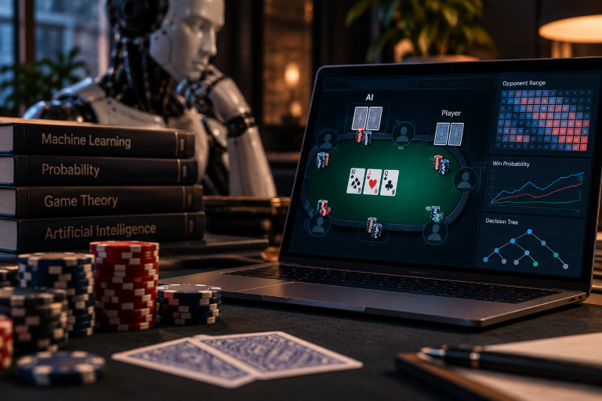
Poker gave artificial-intelligence research a problem that chess could not: much of the relevant information was missing.
A player sees only part of the state of the game. Opponents’ cards are concealed, betting can disguise hand strength, and future cards remain unknown. An artificial player cannot simply calculate from a fully visible position. It has to decide while maintaining competing explanations of what may be happening.
A 2010 University of Groningen thesis examined how that could work in practice. The project combined opponent modelling, probabilistic estimates of unseen cards and Monte Carlo Tree Search, using millions of recorded hands before testing the resulting agent against human participants. The bot never approached superhuman performance. What made the experiment interesting was the way it handled evidence that was both incomplete and systematically biased.
Why Hidden Cards Created a Data Problem
Recorded online Poker hands offered abundant behavioural data: folds, calls, raises and bet sizes could all be observed. The cards behind those actions usually could not. Opponents revealed their private holdings in fewer than 10% of hands.
That absence was not evenly distributed. Hands reaching showdown tended to be stronger than those ending in folds. Training exclusively on revealed cards would consequently produce a distorted sample of play.
The problem resembles selective labels in machine learning. The model receives an answer only in certain cases, and the circumstances determining whether that answer appears are themselves related to the behaviour being studied.
For poker, this meant that simply collecting more hands did not remove the bias. The missing information had to be modelled.
Estimating Cards That Were Never Seen
The thesis used an iterative procedure resembling expectation-maximization.
The model began by distributing probability across possible unseen holdings. It then learned how likely different actions were under those candidate hands and used the betting sequence to revise the probabilities. The updated estimates were fed back into the action model, and the cycle was repeated.
No stage revealed the opponent’s actual cards. The output was a changing probability distribution.
That distinction is important. If the agent had committed to a single guessed hand after an early bet, one mistaken assumption could distort every later decision. Keeping several holdings plausible allowed subsequent actions to alter the picture.
Different Players Required Different Models
The researchers faced another statistical trade-off.
Pooling every player into one model provided plenty of observations but blurred behavioural differences. Building a separate model for each person created the opposite problem: an individual opponent initially supplied too little data.
K-models clustering offered a middle ground. Players were assigned to groups according to which predictive model best accounted for their actions. The models were retrained, assignments were reconsidered, and the procedure continued until membership stabilized.
The resulting clusters differed on measures including aggression and pre-flop raising frequency. That did not prove the discovery of fixed psychological “types,” but it indicated that the models were capturing useful differences in playing behaviour.
From a Range of Hands to a Decision
Estimating an opponent’s cards was only an intermediate step. The agent still had to choose whether to check, call, bet, raise or fold.
Monte Carlo Tree Search supplied that decision layer. The program sampled plausible hidden holdings, possible future community cards and opponent actions, then simulated how the hand might develop. Repeated runs produced estimated values for the available choices.
Its decisions thus depended on two learned quantities at once: the sort of opponent it appeared to be facing and the range of cards compatible with that opponent’s actions.
This integration separated the project from a simple hand-strength predictor. The model was using uncertain beliefs inside a planning procedure.
Human Opponents Exposed the Weaknesses
The live evaluation covered roughly 10,000 heads-up games involving 51 participants. Against novices, performance was approximately break-even. Against participants who described themselves as experienced, the bot lost about 0.7 small blinds per game. The thesis cautioned that the sample was insufficient for strong statistical conclusions.
More revealing was what happened over repeated play.
Experienced participants learned the bot’s tendencies and exploited its predictability. They also used bet sizes uncommon in the historical data on which its models had been trained. Performance deteriorated when human behaviour moved beyond the patterns the software expected.
Those failures make the experiment more instructive, not less. Its central challenge was never simply choosing good poker actions. It was deciding from partial evidence while other agents could adapt, conceal information and behave differently from the training sample.
The thesis offered an early working example of that problem. It also showed where such models break: biased observations, incorrect probability estimates, distribution shifts and opponents who learn the model faster than the model learns them.
Poker involves financial risk and outcomes cannot be guaranteed. Play should remain within personal and financial limits. Anyone experiencing difficulty controlling gambling should seek support from an appropriate responsible-gambling service.


