Penetration Testing vs. Vulnerability Scanning: What Your Business Actually Needs
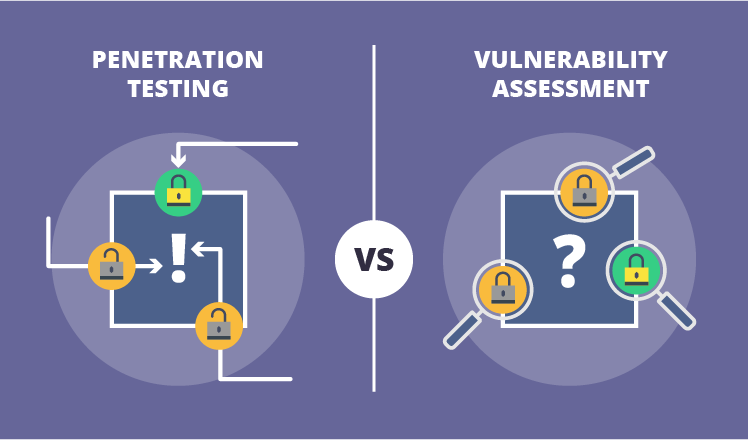
A vulnerability scan is an automated check that lists known weaknesses, while a penetration test is a manual attempt to exploit them and show real impact. Scans are cheap and frequent, and pentests are deeper and less frequent. Most businesses need both, sequenced throughout the year and aligned with compliance requirements.
Security budgets rarely stretch to everything, so leaders often ask whether a scan can stand in for a pentest. The two are related but answer different questions. One tells you what might be wrong, and the other tells you what an attacker could actually do with it.
What Is the Difference Between a Vulnerability Scan and a Penetration Test?
A scan runs software against your systems and compares what it finds with a database of known flaws, such as missing patches, outdated software, and weak configurations. It is fast, repeatable, and produces a long list. A penetration test uses a skilled person who chooses targets, chains weaknesses together, and tries to reach something that matters, such as customer data or admin access.
Businesses comparing penetration testing companies in the UAE will notice that providers describe these services differently, and some sell a scan as a pentest. Asking what a human tester does beyond running tools is the quickest way to tell them apart. Microminder CS is one of several providers in the region that publish this kind of comparison for buyers.
The table below summarizes how the two services differ on the points that usually drive a buying decision.
| Factor | Vulnerability scan | Penetration test |
| Method | Automated tooling | Manual testing, supported by tools |
| Main output | List of known issues, ranked by severity | Proof of exploitation and business impact |
| Typical frequency | Weekly, monthly, or quarterly | Annually or after major changes |
| Relative cost | Low, often subscription-based | Higher, priced by scope and tester days |
| Finds logic flaws | Rarely | Often |
The gap between the two columns is the gap between a list and a story. The next section looks at what a scan can and cannot tell you.
What Does a Scan Detect, and What Does It Miss?
A scan is good at breadth. It can check thousands of hosts and applications against known issues in a few hours, and repeat the exercise weekly at almost no extra cost. For catching a forgotten server, an unpatched library, or an expired certificate, nothing is more efficient.
Its weakness is context. A scanner cannot tell that a low-severity finding on one system, combined with another low-severity finding elsewhere, gives an attacker a path to your database. It also struggles with business logic, such as an ordering flow that lets a user change a price, and it produces false positives that someone has to review. A scan answers whether known flaws exist, but it doesn’t say whether they matter.
What Does a Penetration Test Add, and What Does It Cost?
A pentest adds judgment. The tester scopes the work with you, probes the systems, attempts to chain findings into a realistic attack, and reports what they reached and how. The result is evidence a board or auditor can act on, with fixes ranked by real risk, not a generic score.
Cost depends mostly on scope and depth. A small web application may take a few days of tester time, while a large network with several applications and a social engineering component can take weeks and cost many times more. Prices in the UAE vary widely by provider and scope, so a written scope and a sample report are better comparison points than a headline day rate. Regular scanning between tests reduces the basic remediation a tester has to report, keeping the engagement focused on harder problems.
Which Compliance Regimes Specify One or the Other?
Several frameworks name both activities, and they treat them differently. PCI DSS, for example, requires regular internal and external vulnerability scans and penetration testing at least annually and after significant changes. Frameworks such as ISO 27001 do not prescribe testing, but auditors expect evidence that technical weaknesses are found and managed, and in practice that means both.
UAE sector rules follow a similar pattern. Financial, government, and critical infrastructure organizations are expected to show regular technical testing, and the exact requirement depends on the regulator and the sector. Teams that want a deeper look at how automated vulnerability scanning supports resilience can read the explainer on cyberdb.co, which covers the tooling side in more detail. Before choosing a service, confirm which wording your auditor or regulator actually uses, since a scan will not satisfy a requirement written for a pentest.
When Is a Scan Enough?
A scan alone is reasonable in a few situations. A small organization with a simple, well-patched environment and no regulated data can start with regular scanning and add a pentest as it grows. Internal systems with no internet exposure and low sensitivity also tend to fit this pattern.
A scan stops being enough once something valuable is exposed. Customer-facing applications, payment flows, remote access, and anything that stores personal or financial data justify a human tester. The same applies after a major change, such as a new platform, a cloud migration, or an acquisition.
How Should You Sequence Them Across a Year?
The simplest approach treats scanning as the constant and pentesting as the checkpoint. The steps below show one practical order that many mid-sized businesses follow.
- Run automated scans monthly, or weekly for internet-facing systems, and fix critical findings quickly.
- Fix what the scans find for a few weeks before the pentest, so the tester’s time goes to harder issues.
- Commission the pentest once a year, or after any significant release or infrastructure change.
- Retest the findings after remediation to confirm they are closed.
- Feed the pentest results back into the scan configuration so the same class of issue is caught earlier next time.
That cycle keeps the cheap tool doing the routine work and the expensive human doing the specialized work. It also gives you a clean story for auditors, with continuous evidence and an annual independent test.
Frequently asked questions
Is a vulnerability scan the same as a penetration test?
No. A scan is automated and lists known weaknesses, while a pentest is a manual attempt to exploit them and show real impact.
How often should I run each one?
Scans typically run weekly to quarterly depending on exposure, and pentests usually run annually or after major changes.
Can a scan satisfy a compliance requirement for a pentest?
Usually not. Frameworks such as PCI DSS list the two separately, so check the exact wording your auditor or regulator uses.
Which one is cheaper?
Scans are cheaper, since the tooling does most of the work. Pentests cost more because they rely on skilled tester time.
Do I need a pentest if I already scan regularly?
If you expose valuable systems or data, yes. Scans show known flaws, and a pentest shows whether an attacker can combine them into a real breach.


