Crypto-Funded Live Blackjack Gains Ground Among Ontario Card Players
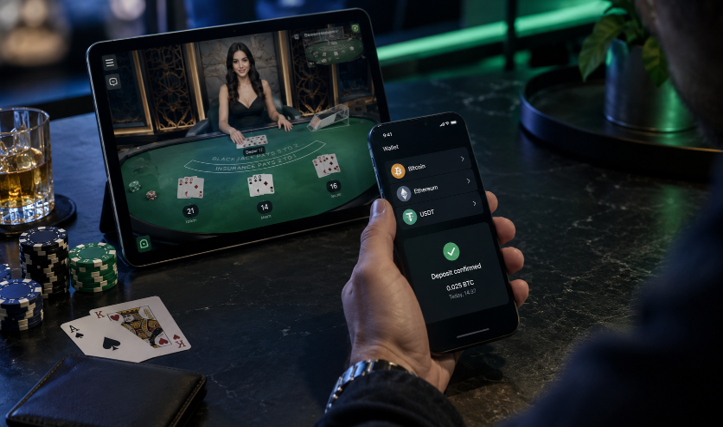
Ontario’s online gambling market has reached a scale few Canadian provinces can match. Yet one form of casino spending remains almost invisible in the official numbers: blackjack sessions funded with cryptocurrency.
The reason is structural. Licensed Ontario operators work through conventional banking and payment systems, while players who want to deposit Bitcoin, Ethereum or stablecoins generally have to look beyond the provincial market. Crypto blackjack is therefore developing alongside Ontario’s regulated sector rather than inside it.
Ontario’s Casino Boom Has a Payment Boundary
According to provincial market reporting, July 2026 produced roughly CA$9.9 billion in cash wagers across Ontario’s regulated iGaming market, alongside about CA$414 million in non-adjusted gross gaming revenue. Active player accounts approached 1.37 million. Casino wagering accounted for close to nine-tenths of the total.
That scale provides important context for live blackjack ontario. Live-dealer games sit within the province’s largest online gambling category, but the payment systems behind regulated tables remain conventional.
ToonieBet Ontario is a useful example. Launched in 2024 and registered with the Alcohol and Gaming Commission of Ontario, the operator lists more than 3,000 casino games, including live-dealer products, while supporting payment methods such as Interac, Visa, Mastercard, PayPal, MuchBetter and Skrill. Cryptocurrency is not listed among its deposit methods.
Crypto Blackjack Falls Outside Ontario’s Measurement System
There is no provincial dataset recording Bitcoin-funded blackjack sessions by Ontario residents on offshore sites. Those transactions do not pass through operators reporting to iGaming Ontario, so they are absent from official wagering and revenue totals.
What can be observed is greater availability of cryptocurrency gambling products aimed at Canadian audiences, more prominent use of stablecoins and wider discussion of rapid blockchain withdrawals. What cannot be established from Ontario regulator figures is the exact size of that audience.
That means regulators can monitor deposits, account activity and gambling behaviour within the licensed system. Offshore crypto transactions sit beyond that reporting perimeter, making it harder to assess how much money is moving into the segment or how player behaviour differs from regulated live casino play.
Why Live Blackjack Puts Payments Under Scrutiny
Cryptocurrency does not change the mechanics of blackjack. Its appeal lies in what happens before and after a session.
Blockchain payments can remove some of the delays associated with bank processing, particularly for withdrawals. Stablecoins also allow users to transfer digital assets without taking on the same price swings as Bitcoin or Ethereum. Offshore platforms may pair those payment rails with higher withdrawal ceilings or fewer verification steps — features that are also precisely what removes the protections regulated players take for granted.
Live blackjack makes those differences more visible because table play often involves defined stake ranges and repeated movement between account balance and active wagers. For a player focused on liquidity, withdrawal timing can become part of the product experience rather than a back-office detail.
Speed, though, is only one side of the transaction. Crypto transfers are normally irreversible. Reduced verification may simplify onboarding while simultaneously weakening the documentation available if an account or payment dispute develops.
The Cost of Leaving the Regulated Perimeter
Ontario’s regulated operators are subject to requirements covering identity verification, anti-money-laundering controls, advertising, player safeguards and operational conduct. Those rules also create identifiable points of accountability when something goes wrong.
An offshore crypto platform may operate under another jurisdiction’s licence, under lighter supervision, or with limited practical recourse for an Ontario customer. Problems involving withheld funds, account suspensions or disputed identity checks can be much harder to pursue when the operator sits outside the provincial system.
That risk is often obscured by discussion of transaction speed. A withdrawal completed in minutes has obvious practical appeal, but payment efficiency is not equivalent to consumer protection.
Gambling is restricted by provincial age requirements in Canada and should be treated as entertainment rather than a source of income. Ontario residents experiencing gambling-related harm can access free and confidential support through ConnexOntario and other provincial services.
The Regulatory Question Has Not Gone Away
The technical ability to accept digital assets is not the obstacle. Payment infrastructure already exists.
Ontario’s harder problem is supervisory: whether cryptocurrency can be accommodated without undermining identity checks, source-of-funds controls, anti-money-laundering obligations and dispute resolution.
Until regulators address that question, crypto-funded blackjack will remain difficult to quantify and largely separated from Ontario’s licensed casino economy. The significance of the trend lies less in the novelty of Bitcoin at the blackjack table than in the part of player activity that provincial market statistics cannot currently see.


